

The Oxford Dictionary defines homeschooling as ‘The practice of educating children at home, not in schools”.
Generally, it refers to parents educating children at home instead of sending them to school. Parents determine:
- What the kids will learn
- Which teaching method is valid
There could be several reasons why parents prefer to educate their kids at home, such as:
- Disapproval of the school curriculum
- Distinct religious or socioeconomic ideologies
- Widespread criticism of the modern education system
The COVID-19 pandemic has brought tremendous challenges. It has impacted almost every sector of society and economy, especially the education sector, as it caused an unprecedented shutdown of schools.
On the other hand, it has also triggered a homeschooling boom[1].
According to a report, nearly 20% of American families now homeschool their children, up from 3% two years ago[2].
Types of Homeschooling
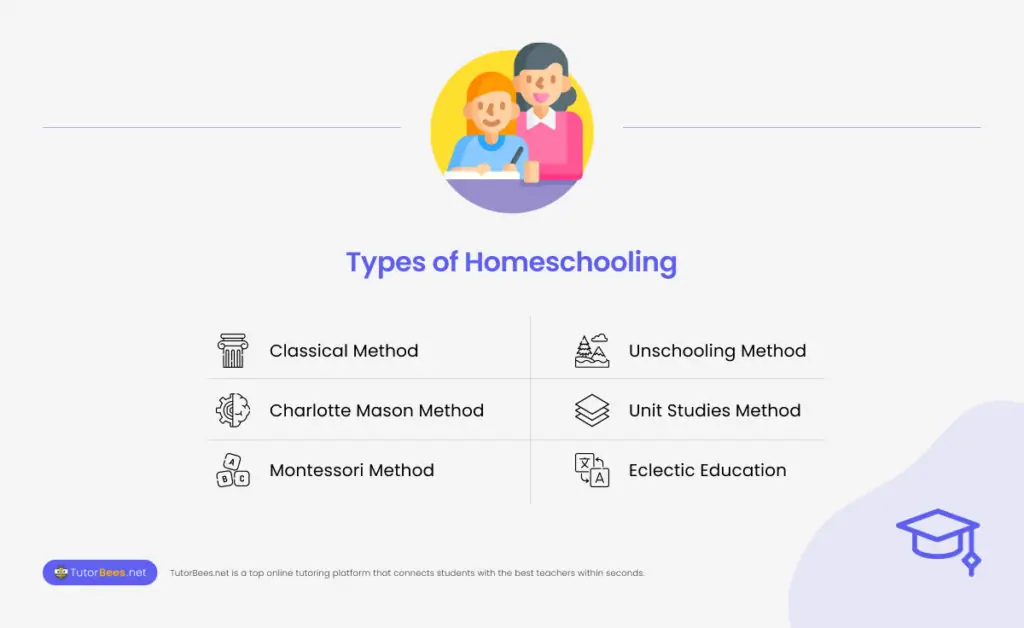
Classical Method
The Classical method is the most popular type of homeschooling, drawing inspiration from the educational techniques of Ancient Greece and Rome.
It emphasizes:
- Classical Greek and Roman texts
- Bible-related education
Students:
- Learn facts and data
- Acquire knowledge of logic, rhetoric, and critical thinking
This method also uses Socratic dialogues, an argumentative question and answer technique used by Socrates, to enhance students’ knowledge.
Charlotte Mason Method
The Charlotte Mason technique extensively focuses on the use of narrative literature.
It encourages:
- Outdoor and nature pursuits
- Living books and narration
- Memorization and nature studies
- Music and picture observations
This approach is:
- Cost-effective
- Flexible
- Allows students to scrutinize subjects directly
Montessori Method
The Montessori method nurtures creative learning and offers personalized interest-focused education compared to formal education.
Children:
- Touch, experience, and interact with everyday objects
- Use toys and tools they encounter
Key features:
- Larger teaching blocks (up to 3 hours)
- Child-sensitive and advanced learning approach
Unschooling Method
The Unschooling method follows an unconventional approach. It is embedded in the principle that time and place do not restrict learning.
It focuses on:
- Reading
- Writing
- Arithmetic skills
It also facilitates learning through:
- Technology
- Varied materials
Suggested Read:
Why Should Kids Read William Shakespeare?
Unit Studies Method
The Unit Studies technique emphasizes thematic learning.
Students learn a particular topic from multiple subject perspectives.
Example:
- French Revolution → History
- France → Geography
- Learn French → Language
This method:
- Offers flexibility
- Combines varied learning approaches
Eclectic Education
The Eclectic Education method is one of the most popular homeschooling methods.
It:
- Fuses various methodologies
- Adapts to learner needs
There is no fixed structure, and parents can:
- Combine multiple homeschooling methods
- Mix approaches based on context
Example:
Explore nature using the Charlotte Mason method while on other days interact with toys using the Montessori method.
Homeschooling Benefits
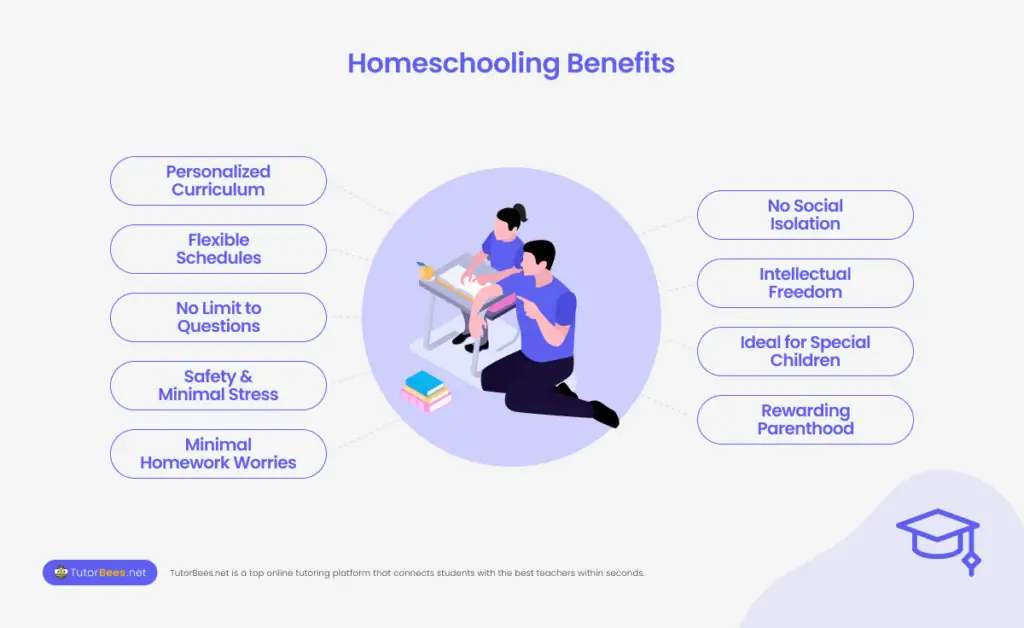
Personalized Curriculum
The education curriculum of homeschooling allows parents to:
- Modify curriculum
- Adjust teaching methods
Students receive personalized one-on-one education.
Flexible Schedules
Homeschooling enables families to avoid rigid schedules.
Parents can:
- Set suitable learning times
- Plan extracurricular activities
No Limit To Questions
In traditional schooling, children may not get all answers.
However, homeschooling allows:
- Unlimited questions
- Personalized responses
Safety And Minimal Stress
Learning at home safeguards children from:
- Peer pressure
- Bullying
- Drug exposure
It also:
- Reduces academic stress
- Allows flexible workload
Minimal Homework Worries
Kids are unswervingly involved in the learning process; hence there is little or no need for homework. It can save a parent’s time and lessen the study burden on children.
No Social Isolation
It is a myth that homeschoolers lack social skills.
Children can:
- Build friendships through activities
- Interact with different age groups
Also Read:
Online Extracurricular Activities for Kids
Intellectual Freedom
Traditional schooling offers limited intellectual freedom.
Homeschooling:
- Encourages independent thinking
- Builds problem-solving ability
Students:
- Become self-directed learners
Ideal For Special Children
Children with:
- Physical challenges
- Developmental issues
- Emotional or sensory disorders
Benefit from:
- Personalized attention
- Reduced social stigma
Rewarding Parenthood
Parents are deeply involved in the homeschooling process.
This:
- Strengthens family bonds
- Creates meaningful learning experiences
Drawbacks
Slower Pace
Without proper knowledge, parents may:
- Struggle to teach effectively
- Slow down learning progress
This can lead to:
- Confusion
- Reduced interest in education
Expensive
Homeschooling can be costly because:
- No public funding is available
- Parents bear full expenses
Costs include:
- Curriculum
- Activities
- Field trips

Lack of Proper Facilities
Homeschooling may lack access to:
- Large libraries
- Science labs
- Sports facilities
Huge Parental Responsibility
Parents must:
- Take full teaching responsibility
- Manage schedules
- Balance multiple roles
Conclusion
Parents prefer homeschooling over traditional schooling due to:
- Curriculum concerns
- School environment issues
Homeschooling:
- Offers numerous benefits
- Can be highly rewarding
However:
- It also has drawbacks
- It may not suit every family
A thorough assessment of pros and cons is essential before making a decision.
Also Read
- 13 Homework Benefits For Your Kids
- Top 7 Things your Kid Might be Doing That Kill Brain Cells
- Online Tutoring: What Is It & How to Benefit the Most From It?
References
[1]
“The Pandemic Set Off a Homeschooling Boom. Don’t Be So Sure That a Bust Is Coming.”
Reason.com
[2]
“Nearly 20% of American Families Now Homeschool, Up From 3% Two Years Ago.”