


Two words carry this whole idea, and their roots explain them better than any definition.
The two words
Aqeeda
Aqeeda (عقیدہ) comes from the root ع ق د, which means to tie a knot. The same root gives aqd, the tying of a contract. Aqeeda is what you have tied so firmly inside you that it doesn’t come loose when pulled.
It asks: what do I hold to be true? And it does not change.
Shaoor
Shaoor (شعور) comes from the root ش ع ر, which means to perceive. The same root gives shair, the poet, who notices what others walk past. Shaoor is being awake to the exact situation you are standing in.
It asks: what is actually happening here? And it changes every single time.
The qibla and the route
The qibla never moves. From Lahore it points the same way today, tomorrow, and in fifty years. That is aqeeda.
The route you take through the city changes daily. A road is dug up, an underpass is closed, a wedding blocks the street. You look at what is in front of you and decide. That is shaoor.
Or think of a tree. Roots stay put, and branches bend. If the roots can’t hold, the first storm takes the tree. If the branches can’t bend, the same storm snaps them.
جڑ مضبوط، شاخ نرم
Strong roots, flexible branches.
Shaoor changes how you act on a principle, never what the principle is. Bending a branch is not uprooting the tree.
Four ways people show up
Combine the two and you get four patterns. Most of us move between them depending on the day:
- Both: They know what they stand for and read the room well enough to act on it.
- Aqeeda, no shaoor: Right about the facts, wrong about the moment. They cause damage while being correct.
- Shaoor, no aqeeda: Charming and agreeable to everyone, and they stand for nothing.
- Neither: Drifting without conviction or awareness; careless.
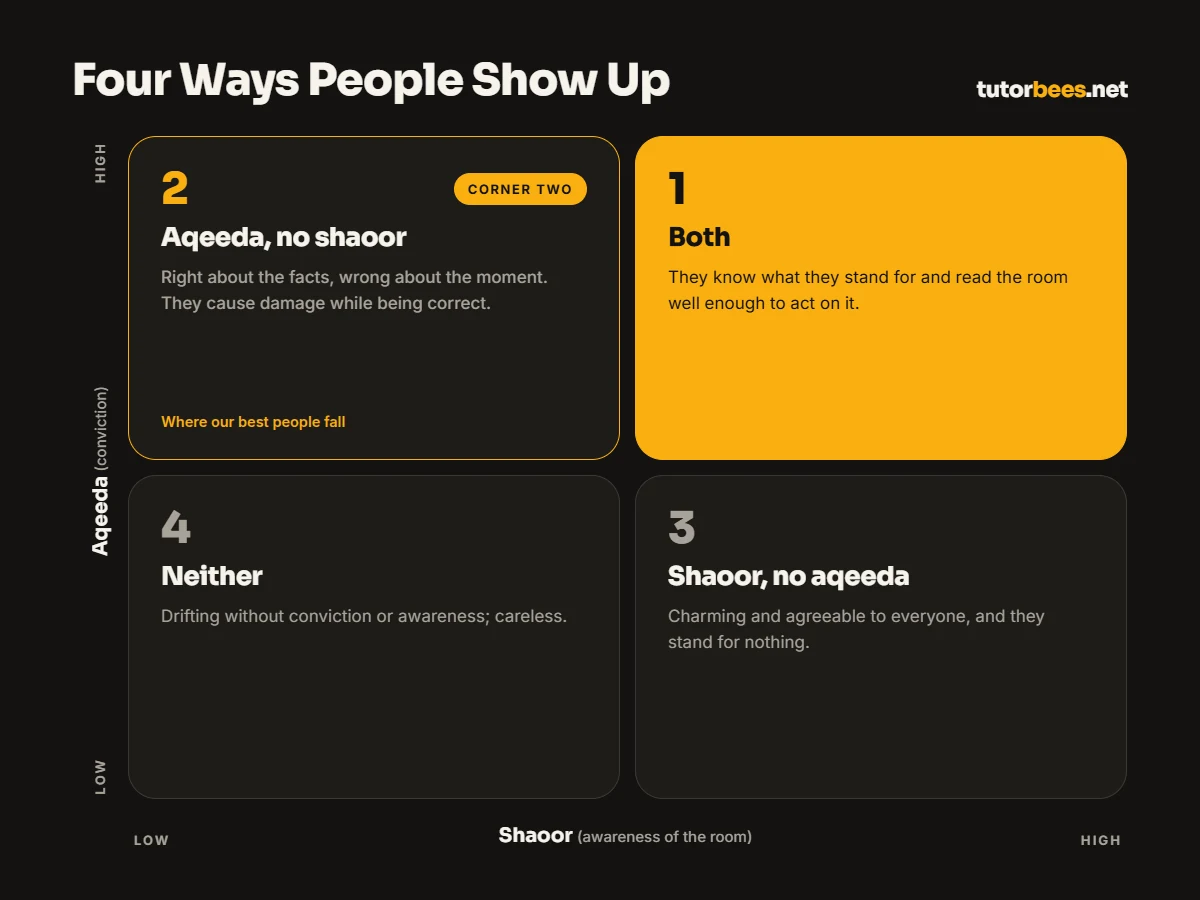
Corner two is where our best people fall. Someone honest and principled humiliates a person in front of a room, then defends themselves by saying they were telling the truth. They were. That is precisely the problem.
The fix is small: a 10-second pause before you speak.
Seeing it in real life
The right answer, badly delivered
A teacher makes a small mistake on the board, and you are certain. Aqeeda knows what is correct. Shaoor decides whether to say it loudly in front of thirty people or quietly afterward.
The guard at the gate
He has opened it every morning for nine years, and most people walk past without looking up. Nobody did anything wrong. Shaoor is simply noticing that a person is standing there at all, in July, in that heat.
Try this
Knowing the two words only helps if you remember them in the moment, so build the 10-second pause into how you act. Before your next difficult conversation, take those 10 seconds and ask:
- What do my principles require here?
- What does this moment call for?
Afterwards: I was right, but was I helpful?